











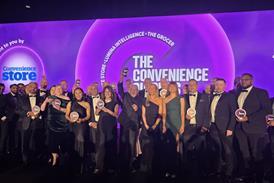




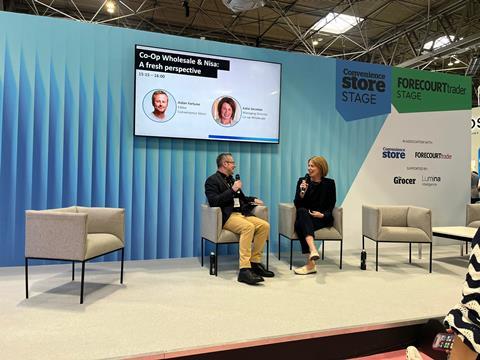
Speaking at the National Convenience Show at the NEC in Birmingham, Co-op Wholesale managing director Katie Secretan outlined the main challenges and opportunities facing retailers and how it has shifted its relationship with retailer partners.
Co-op Wholesale and the Co-op Group has been in the press of late, most recently with the results showing a decline in revenue. Secretan explained how it had been a “relatively difficult” year for the business.
“The Co-op Group has had a relatively difficult year and the results obviously have shown that. Those results are based mainly on the cyber incident that we had last year and our real struggle to recover coming out of that, which was difficult.”
“We found actually lots of issues in our business that we sought to solve, actually, as we recovered from the cyber attack.
She went on to explain how the business decided to focus on change.
“Part of my appointment was that we would rebrand the business, so we moved from what was Nisa to Co-op Wholesale, and we set out with a very significant plan of turnaround and change, and that started with understanding retailers and customers and working out what we were doing well, what we were not doing so well, and putting a really clear plan in place.
“At beginning of last year, just before I took the post, we put a survey in place with retailers and our competitors’ retailers, managed by KPMG, to ask customers what was important to them and how good were we at that.
“What they told us were that we were really good at some of the things that we hold in high regard - our own brand is fantastic, our distribution service is brilliant, our availability is second to none.
“But what we’re not so good at is some of the pricing around our promotional activity. We have brilliant rebates, but we take that away with really complicated surcharges and messy contracting.
“We’ve been really clear about what we need to do, and then literally have started doubling down on some of those things that retailers told us specifically. That’s in price, that’s in promotion, and that’s extending the range to be really clear about the segmented and targeted audiences that we have.”
Nisa relaunch
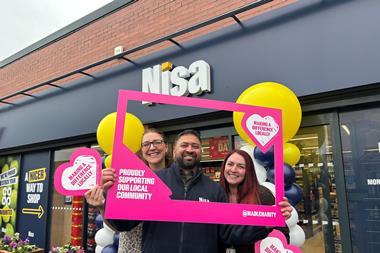
Secretan also provided an updated on the Nisa format relaunch which was unveiled at Nisa Dallam earlier this year.
“We have seven stores that are up and running and 100 stores in pipeline - we have more retailers who want the store format than we can get to quickly which is a really good sign.”
She explained that the new offering was a way of providing more for retailers. “What I noticed in our wholesale business was that we have got some brilliant parts of our toolkit but we weren’t wrapping them together for retailers. And that’s where this idea of the relaunch of Nisa came about, which was really to make sure that we’re encompassing all of that support.
“This launch is all about making sure that we’re absolutely in it, in a partnership way to deliver the services that they need to deliver to their consumers. This proposition is all about taking a retailer who really wants to access some of those premiumised wholesale services and some of the extra investment that we’re offering in return for that kind of loyalty of buying with us.”
Rising costs and changing shopper behaviour
Looking ahead, Secretan highlighted some of the challenges and opportunities facing the sector.
“The cost of moving goods globally is a huge problem for all of us right now and including the challenge of how do we make sure that supply remains consistent, availability is king for retailers,” she explained. “So we’re working really hard on that and currently we’re swallowing all the costs that come with that.
“But what we know is that suppliers and retailers just can’t swallow all of those themselves, so there is inevitably going to be a cost challenge that comes down the line and the longer the conflict in the Middle East goes on and the longer we squeeze the economy, the harder that is going to be.
“While that’s going on, consumers are tightening their belts, and we just can’t be passing all of this on to consumers in a world where they simply don’t have that cash to cope with it. We’re already seeing forecourts losing footfall and we’re seeing basket spends being lower.”
From an opportunity point of view, shifting shopper habits was key.
“The Co-op Food Group and as a wholesale business, we major on missions including lunchtime food for now and meals for tonight.
“If you think about that meals for tonight mission, and the world that we live in today where people’s pockets are squeezed more, I talk about the restaurant and takeaway numbers quite a lot because they astound me at how much they’re moving.
“Traditionally when restaurant bookings go down, takeaway numbers go up. Actually now restaurants are going down, takeaway is going down and people are popping into the forecourt on the way home or the convenience store buying a really good quality meal for tonight. Those the missions that are really growing for us and that’s where we see the growth in numbers.
“Fresh is also growing. We live in a world where people like to be healthier and we have more creative cooks than maybe ready meal kings like we used to.
“We know that four million families now only shop convenience. Many of those families would previously have shopped supermarket, but they only shop convenience because it’s a better and easier way for them to manage their budgets. So that’s a real opportunity for us. If we get the right value offerings in place, the right promotions, the use of own brand, really high quality at good value, we know that’s a great opportunity for retailers.”
Pricing concerns
Secretan also addressed retailer concerns regarding pricing for Co-op Wholesale partners, with some complaints citing that the retail price of certain lines in Co-op Group stores were less than what Co-op Wholesale partners could buy them for.
“About 18 months ago, probably, that was at the height of its challenge. When the wholesale business was bought by Co-op, the Competition & Mergers Authority allowed it to stay as a competitor on the high street to Co-op, and within the rules of being a competitor is not sharing the same pricing policy or the same pricing strategy. So, it’s really important that we deliver to that. We can’t work on the same pricing strategy and neither should we.
“Secondly, we are talking to a different shopper group in Co-op Wholesale than you are in the Co-op Group so the pricing strategy should be different. That said, if I can buy a product cheaper in Co-op than I can buy it from my wholesale partner, I’m probably going to be upset about that and I understand that was some of the challenges that were raised by retailers. I’d like to say that situation is very minimal these days, and it was one thing that I really focused on.
“I don’t have the ability to look at what pricing Co-op will put into their stores on a promotional basis, but I can look at the market and work out where I want to be.
“In October, we took a different approach in separating our pricing team from that of the Co-op. So whilst we use the benefits of buying as a whole, actually the proposition is now entirely separate. I think it’s really important that we as a wholesale business can price and promote exactly as we wish to for our customers, regardless of where Co-op is.
“We’re still working hard to always be cheaper, but in the economy it’s pretty difficult, but I think we’ve made good headwinds.”







No comments yet