


















Exchange For Change has confirmed the fees that will be paid to return point operators when the Deposit Return Scheme (DRS) launches in October 2027 in England, Scotland and Northern Ireland.
The Return Handing Fee (RHF) will operate on a tiered basis across manual and automatic return points and will provide for small to large volumes of returned containers.
Following an industry consultation, Exchange For Change has set the RHF at:
Manual return points: 3p per container
Automatic return points
Tier 1: 5p per container, up to 225,000 in-scope items returned annually
Tier 2: 1.3p per container, for annual in-scope returns in excess of 225,000
The RHF will be reviewed early next year prior to the scheme going live, and it will continue to be reviewed annually to take account of new data available from producers and retailers, as well as to consider other relevant factors.
This annual review will use real data collected during operation of the scheme, which will build a profile of the RHF and factors that impact it, thereby ensuring the assumptions and data inputs become more robust every year.
Exchange For Change CEO, Russell Davies, said: “We have taken onboard a wide range of feedback provided by retailers, producers and trade bodies, and established a return handling fee that reflects the complexities of the UK retail landscape and ensures the scheme remains in balance.
“The UK’s retail landscape is unique in the world, spanning large supermarket chains, medium-sized franchises and a very high ratio of small and independent convenience stores comparative to other nations.
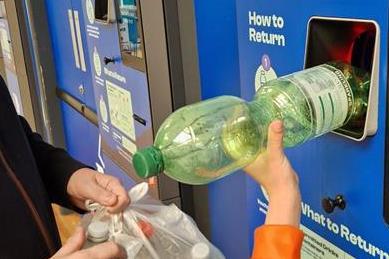
“This means the network of return points across the UK will be extensive, and the nature of collections will range from small convenience stores manually collecting and returning a small amount of containers, through to large multinational supermarket chains operating multiple reverse vending machines that collect several thousand containers each week at every store. The RHF reflects this diversity in our retail sector, and delivers a fair scheme for all.”
Industry reaction
The announcement was met with disappointment by the Association of Convenience Stores (ACS). It said that modelling carried out in consultation with the convenience sector suggests that the fixed costs of providing an RVM in store are likely to run beyond £10,000 a year, which would mean that retailers would have to see returns of at least 4,000 containers a week/208,000 containers a year to break even.
ACS warned that there will be stores that see return rates of between 2,000 and 4,000 containers a week and will lose money every year as a result of participating in the scheme.
ACS chief executive Ed Woodall said: “Hosting a return point should be cost neutral for local shops, but the handling fees announced today will mean some neighbourhood convenience stores will be net losers under the deposit return scheme or force them to run burdensome manual return points.
“Convenience retailers want to be part of the scheme and providing those services in their community, but they should not be financially punished for doing so. We hope that Exchange for Change will continue to look closely at the handling fees to optimise the network of return points for customers and all convenience retailers.”
The Fed’s National President Hetal Patel said: “The retail handling fee is a very important element of the whole scheme. While we would have preferred higher rates, the fees announced are not unexpected and we welcome certainty about what they will be.
“As a member of the advisory board for Exchange for Change, we have engaged closely with the consultation exercise and highlighted the importance of independent retailers like our members fully participating in DRS to drive up recycling rates. Throughout this process, we have stated that DRS must be cost-neutral for small shops and called for handling fees that help them cover their costs.”
He added: “We have some concerns about the direct and indirect costs associated with DRS – including things like capital, labour, maintenance and lost floor space. We await final details on key aspects like grants for those hosting reverse vending machines – which we have backed – as well as criteria around exemptions.
“There remains a lot to do for all stakeholders in retail and elsewhere to prepare ahead of the launch in Autumn next year, and we will continue to work closely with Exchange for Change to ensure DRS works for our members.”
In April, Exchange for Change announced that a flat 20p deposit will be applied on all in-scope containers when the scheme launches. The Welsh government has yet to appoint a Deposit Management Organisation (DMO) for the operation of its DRS in the country.











No comments yet