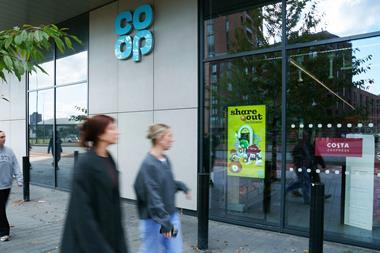
A new study released by Co-op Media Network (CMN) has unveiled how shopper behaviour differs across small and large store formats.
Research from CMN, in partnership with consultancy Trinity McQueen, suggests most convenience store shoppers are led by mission-based behaviour such as ‘something for dinner’ or ‘I’m thirsty’ – without a plan to purchase a specific product or brand, underestimate how much they will buy, are more committed to making a purchase and are more open to guidance from in store ad campaigns.
As part of this study, CMN and Trintiy McQueen ran a combination of accompanied shops and post-purchase interviews in three large and three small Co-op stores to understand the psychology and habits of shoppers across both formats.
A key finding showed 68% of shoppers visit a convenience store with no set list – written or mental – and shop with a mission or need in mind. The large store data showed the opposite pattern, with more planning, stronger intent and less flexibility. Importantly, this research indicates that customers in a convenience setting have a stronger reliance on in-store prompts to guide their decision making.
“Shoppers in smaller convenience store formats underestimate how much they will purchase on their trip.”
Furthermore, the research uncovered that shoppers in smaller convenience store formats underestimate how much they will purchase on their trip, with many customers picking up a basket mid-shop after selecting more products than initially planned. Small formats were also highlighted as prime locations for brand discovery, with shoppers expecting to see choices that are new and different.
The data also revealed that the first brand or product a shopper sees in store largely influences their final purchase, reinforcing the importance of brand visibility at fixture in smaller formats.
Finally, the behavioural study suggested that shoppers are more committed to making a purchase in small stores. Convenience formats have a captive audience and 88% of shoppers will complete their mission in-store and purchase a substitute product if their planned product is not available, rather than seeking other options elsewhere.

Kenyatte Nelson, chief membership and customer officer at Co-op, said: “Convenience is different and this new behavioural study further supports the importance and influence of small store advertising campaigns.”
Becki Jarvis, research director at Trinity McQueen, added: “Our study with Co-op shows convenience store shoppers arrive with fewer fixed plans, greater openness to persuasion, more willingness to experiment and a stronger reliance on in-store to guide their decisions.”
You can now secure your tickets to the Convenience Awards 2026!
Join us on 11 March in Liverpool to celebrate the entire convenience community.
See this year’s finalists and book your seat here.


No comments yet