










Thirteen months to go: c-store retailers should see the DRS as an opportunity, not just a challenge. Here’s how to make the scheme work for you — driving footfall, building loyalty and making a genuine difference in the local community.
With just 13 months to go until the UK’s landmark deposit return scheme (DRS) for drinks containers goes live, it’s time for convenience retailers to step up their preparations.
The latest news is that Exchange For Change, the not-for-profit organisation delivering the scheme, is making available £60m in grant funding to help up to 10,000 small, independent retailers meet the cost of installing Reverse Vending Machines (RVMs) across England, Northern Ireland and Scotland. Grants of £6,000 will be awarded to qualifying indie retailers in three payments of £2,000, three months after they’ve installed an RVM.
“Retailers will play a fundamental role in transforming how we increase recycling and reduce litter in every corner of the UK through the deposit return scheme,” explains Russell Davies, Exchange For Change CEO.
“Along with confirming the return handling fee, we’ve announced a package of support, developed following extensive consultation with industry, to help retailers of different sizes make the best choice for their business. This includes extending return point exemption criteria and providing grants to help small, independent retailers meet the cost of installing RVMs,” he adds.
The introduction of a national DRS represents a big change for all retailers, but the impact is often greatest in convenience, says Sondre Henningsgård, UK managing director for Tomra Collection UK. He explains that convenience stores are typically working with less space, tighter budgets and smaller teams, all of which means that “adding a new operational process can feel like a real challenge”.
Henningsgård believes some retailers will see DRS purely through the lens of compliance, however others will view it as an opportunity to drive footfall, build loyalty and create a point of difference in their local area.
“What we consistently see from our research across seven DRS markets is that the majority of shoppers (9/10) choose to spend their deposit refund in the same store, and because returning containers is often a planned trip, these customers tend to have a larger basket than average. That creates a real opportunity for incremental sales,” says Henningsgård.
It’s a point echoed by Samantha Walker, DRS project lead for Coca-Cola Europacific Partners (CCEP). “The insight from other markets, particularly Ireland, is that there can be a real commercial benefit for convenience retailers from hosting a return point, both in driving footfall and spend in store,” she says.

Sourcing an effective in-store solution
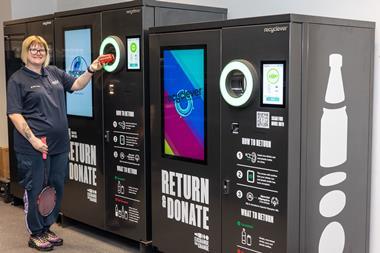
Convenience store owners participating in DRS will need to make a series of key decisions over infrastructure, chief among which is how to collect returned bottles. There are effectively two options: manual take-back or the use of a (RVM). Henningsgård suggests that although manual take-back may seem simpler on the surface, it puts more pressure on staff to check containers, can slow down the customer return experience and may require greater space back-of-house to store containers. Reverse vending, by contrast, automates the process, making it quicker and easier for shoppers while reducing handling for store teams.
“Retailers that want to provide a smooth experience for both customers and staff should be looking closely at automation,” Henningsgård advises.
RVMs come in all shapes and sizes: from compact machines for smaller stores to higher-capacity solutions for busier locations. “The right choice depends on expected volumes, store location and the customer experience,” says Henningsgård. “Smaller stores understandably want smaller machines, but capacity still matters. If bins fill too quickly, staff are constantly emptying them and customers experience downtime, so it’s about balancing footprint with running a machine efficiently in a store environment.”
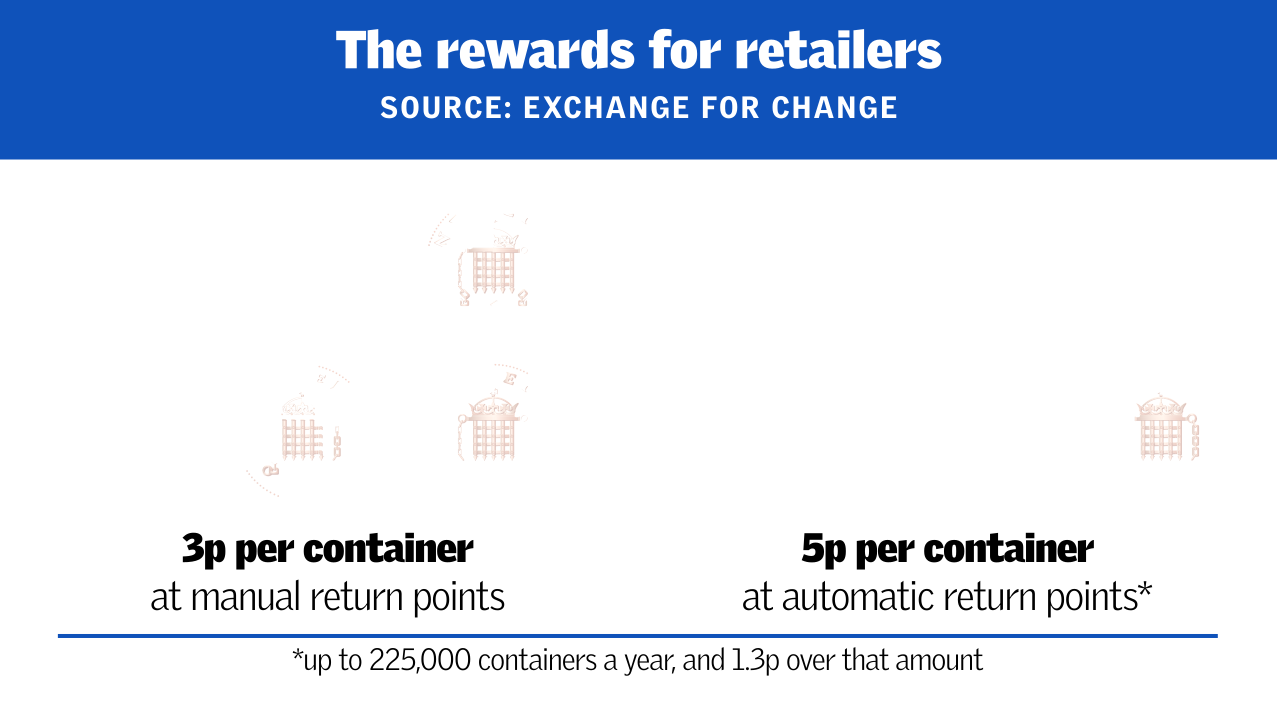
Retailers operating a return point will receive a return handling fee which has recently been set by Exchange for Change at 3p per container for manual return points. Fees for automatic return points have been set on a tiered basis at 5p per container up to 225,000 containers per year, and 1.3p per container for returns in excess of 225,000 per year. Convenience retailers may also be able to access grants of £6,000 per site over three years to support DRS running costs, with eligibility criteria to be published in due course.
Getting support to succeed
One of the biggest decisions store owners will need to make is over where to locate the RVM. Some retailers in countries where DRS is already operational have chosen to locate their machine outside the store, in the car park for example, while others have chosen to keep it inside. Henningsgård says the decision will be influenced by factors such as space, layout and customer flow, adding: “The most important thing is to design the experience from the shopper’s perspective.”
Aaron Massey, a Costcutter store owner from Windy Arbour in Dublin, says he tried to focus on the customer’s viewpoint when choosing where to situate his own RVM. He settled on a position inside the store, near the tills and drinks. “The machine might not be situated exactly where we would want to have it from a practical perspective because every inch of store space is so valuable, but it’s in our benefit to have it positioned in a way that is as easy and convenient for the customer as possible,” Massey says.
Walker at CCEP notes how it’s vital too for stores to communicate to customers that they operate a return point through the use of leaflets, display boards and other directional signage. She adds that over the next 18 months CCEP will deliver its own communications programme with the aim of helping independent retailers prepare for DRS, including insight into the opportunities the scheme presents and the changes in behaviour shoppers are likely to make.
Henningsgård highlights how Tomra provides ongoing operational support to convenience retailers using its machines, with named technicians supported by remote monitoring and preventative maintenance to resolve issues early and fix problems quickly when needed.
His concluding advice to convenience retailers is to be clear on the role DRS will play in your store, because that decision shapes everything that follows. “The worst thing you can do is nothing,” Henningsgård says. “Those who plan early, choose the right solution and focus on the customer experience are the ones who will get the most value from DRS.”
Find out more about Tomra’s reverse vending machines and how CCEP is reducing the impact of packaging.