




















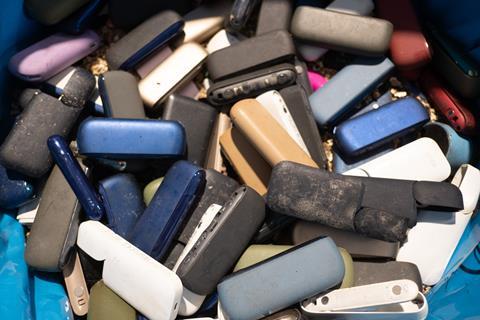
The latest estimate from recycling organisation Material Focus has shown 6.3m vapes and pods are thrown away or incorrectly recycled in the UK every week.
It’s a figure that will be unsurprising to the team at pouch brand Übbs, who’ve just released the results of a survey of 1,001 UK adults to better understand how people dispose of vapes - and what they know about the batteries inside them.
Respondents were asked about about vape waste, battery disposal and recycling habits, and the results were compared with wider published research on the scale of the problem.
The results paint a clear picture - most people know vaping has a waste problem, but far fewer understand how big it really is, or what should actually be done.
Millions of vapes and pods are still being discarded every week, and the lithium-ion batteries inside them can create both a resource-loss problem and a fire risk when they end up in general waste or household recycling.
Key findings from the survey
62% know vapes contain batteries, but 56% have never thought about what happens to them after disposal.
46% would dispose of a used vape through general waste or household recycling.
Only 12% correctly estimated that more than 10m vapes are discarded in the UK each week.
Battery-related waste fires have increased by 71%, highlighting the risks of batteries entering the wrong waste stream.
33% said a cash-back or deposit scheme would most encourage them to dispose of vapes responsibly.
In addition, A huge 56% of respondents told Übbs they’d never thought about what happens to the battery inside a vape once it’s thrown away. Only 16% said they think about it regularly, while a further 28% said they think about it occasionally.
Widespread confusion
Only half (50%) of people believe vapes can be recycled at all, while 30% weren’t sure and 21% believe they can’t be recycled.

When Übbs asked people what they’d do with a used vape, 31% said they would take it to a proper recycling point. However, 30% said they would put it in general waste, while a further 16% would put it into household recycling.
This highlights a clear gap between awareness and behaviour. Vapes contain batteries and other electrical components, so they need to be handled differently from ordinary household waste. If a battery is crushed or damaged during collection, sorting or processing, it can create a fire risk.
When asked what would most encourage people to dispose of vapes responsibly, a cashback or deposit scheme came out on top, chosen by 33% of respondents. This was closely followed by more recycling points in shops, at 31%.
The preference for financial incentives was particularly strong in some groups. It was the most popular answer in Northern Ireland, where 50% selected a cashback or deposit scheme, and in Belfast, also at 50%.
Among 45 to 54-year-olds, 38% selected a cash-back or deposit scheme.
Electrical scheme
Vapes fall within the UK’s Waste Electrical & Electronic Equipment (WEEE) framework. Retailers that sell vapes are already required to provide a way for customers to return used vapes for recycling. GOV.UK states that businesses selling vapes must take back waste vapes in store or provide an alternative collection point.
This applies to used vape devices and vape parts, including batteries.
Right direction?
The latest Material Focus research suggests the 2025 ban on disposable vapes has made a measurable difference. The number of vapes and pods thrown away as mentioned earlier has actually fallen - from 8.2m in 2025 to 6.3m in its latest figures.
”Illegal or non-compliant products may still be making their way onto the market.”
There are also questions around how easy it is for consumers to tell whether the vape they’re buying is legal and compliant with the rules. The continued availability of single-use-style vapes suggests that illegal or non-compliant products may still be making their way onto the market.
Ultimately, the disposable vape ban has reduced the amount of vape waste being generated, but it hasn’t removed the wider challenge. Millions of vapes and pods are still being discarded every week, making proper recycling and vape waste disposal just as important as ever.
The full results of the Übbs survey and its impact can be read here.









No comments yet