
















One of AI’s latest manifestations is a cute, furry little beast with a smiley face. He’s part of Meta, he’s called Muse and he’s a personal AI agent. He can do your Christmas shopping or search for a cheaper energy deal.
Launched in the US earlier this year, Muse has just been made available here in the UK and it seems some retailers are falling over themselves to get connected. Meta says Muse is already working with “UK connector partners” such as Marks & Spencer, Ocado Retail, Sainsbury’s and JD Sports. With some of these brands, users can connect their personal account with Muse so he can reorder your usual shop or pull up a booking. With others, Muse can help you find what you need from the retailers’ websites.
Shruti Dube, UK country director at Meta, says Muse works seamlessly with services people use every day, making everything from the weekly shop to sorting out their travel needs easier.
However, Meta might have its work cut out getting consumers to sign up to Muse as, according to YouGov survey data, only 21% of Britons say they trust AI in the retail sector, combining 2% who say they trust it a lot and 19% who trust it somewhat. Meanwhile, 37% say they don’t trust it (17% do not trust it much, 20% do not trust it at all), and the rest are either neutral (29%) or unsure (13%).
Consumers might not be particularly trusting of AI but more and more retailers are using it across their business.
The next step
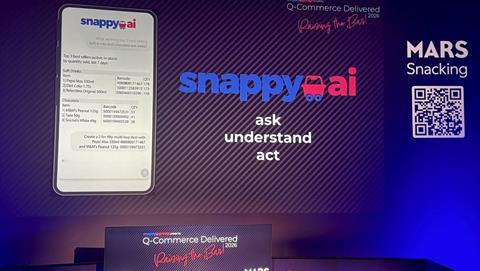
At the Q-Commerce Delivered 2026 show in September, Snappy Shopper unveiled what it described as the “next step in helping retailers get more from their delivery business”: Snappy AI. Designed to make running and growing a delivery business simpler, Snappy AI aims to help retailers understand what’s happening across their store, decide what to do next and take action. Instead of digging through reports or dashboards, retailers will be able to ask questions in everyday language and get the information they need.
Questions like: “How did my store perform last week?” “What are my best-selling products?” “Which products aren’t selling well?” “How are my deliveries performing?”
And “What could I do to grow my sales?”.
But Snappy Shopper says its AI isn’t just about providing answers, its real value is in helping retailers take action. For example, they will be able to ask Snappy AI to complete everyday tasks on their behalf, such as creating a deal on their menu.
The company says Snappy AI is being designed around a simple principle: technology should make running a convenience store easier, not more complicated.
Meanwhile, one leading petrol retailer told us that he pays a subscription so his staff have access to AI and they love it, using it every day for analysing store sales and finding out which products sell best in their trading area.
Rafael Renteria, vice president of channel sales at telecommunications experts Call Tower, believes that for independent retailers, the value AI brings is through reducing administrative workloads.
“Modern communications systems have tools like call and email summaries to reduce everyday admin, but also intelligent call routing and AI virtual agents to address customers’ queries and enhance the retail experience.
“If AI assistants are integrated into back-end systems like stock management software or CRM platforms, then retailers can use them to access information quickly and respond to customers faster. Ultimately, AI is reducing the time retailers spend on repetitive tasks, allowing them to focus on providing responsive, personalised customer experiences that keep shoppers coming back.”
Safe and secure
Much of the conversation around AI in retail focuses on operational efficiencies, improving the customer experience and reducing costs. However, Nick Fisher, CEO of Facewatch, believes one of its most important applications is in helping to protect the people who work in retail.
“AI-powered live facial recognition is a good example of technology addressing a very real and longstanding problem for retailers – persistent theft, abuse and violence against shop workers,” he explains. “It enables retailers to identify known offenders in real time, giving colleagues an opportunity to take preventative action in accordance with their own store policies and procedures.
“As AI becomes more embedded in the retail environment, retailers need to look beyond what the technology can do and ask searching questions about how it is governed, how risks are managed, where accountability sits and what safeguards are in place.
“Human oversight, for example, is fundamental to the way Facewatch operates. AI supports human decision-making rather than replacing it. Our facial recognition technology uses two separate algorithms, with matches independently reviewed by a trained facial analyst before an alert is issued to a retailer.
Earlier this year, Facewatch achieved certification under ISO/IEC 42001, the world’s first international management system standard dedicated to artificial intelligence. Fisher says this provides retailers with independent assurance that Facewatch’s use of AI is subject to a formal, independently audited governance framework.
“The real opportunity for AI in retail is to deliver tangible benefits to businesses, their employees and their customers. But the pace of technological innovation must be matched by the development of robust governance and safeguards. That is fundamental to building and maintaining public trust.”
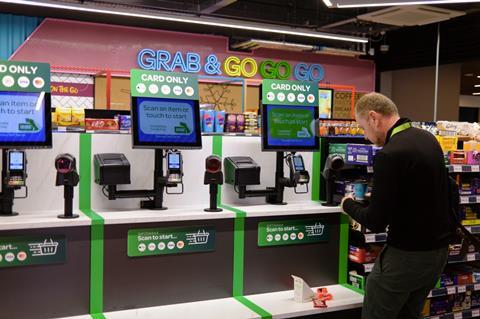
Another company using AI to help stop shop theft is Henderson Technology, which is currently trialling two AI-powered monitoring solutions, Trigo and ScanWatch, on its EDGEPoS self-checkouts, with the primary aim of improving loss prevention.
Darren Nickels, retail technology operations director at Henderson Technology, explains: “By combining computer vision AI with point-of-sale analytics, the technology can identify items that have not been scanned in real time, enabling action to be taken before a transaction is completed. For busy convenience stores, where colleagues are often managing multiple tasks, this technology provides an additional level of monitoring and support, helping retailers to reduce stock losses and protect profitability. The trials will enable us to evaluate how AI can further enhance our EDGEPoS technology and deliver practical commercial benefits for retailers.”
This AI-powered monitoring adds an extra layer of security to self-checkouts by using cameras and intelligent software to identify items that customers have not scanned, whether accidentally or deliberately.
ScanWatch focuses specifically on activity at the self-checkout, identifying unscanned items and alerting the customer, giving them the opportunity to correct the error. If the item remains unscanned, the system calls a member of the store team to intervene.
Trigo provides wider store coverage by monitoring activity throughout the customer’s shopping journey, including detecting walk-outs and identifying items that have not been presented at the self-checkout.
Nickels explains: “For convenience retailers, the aim is to use AI alongside EDGEPoS to identify potential stock losses as they happen, while enabling colleagues to focus on serving customers and managing other areas of the store. Ultimately, it is about helping retailers protect their margins while retaining the convenience that self-checkouts offer customers.”
Customer experience
AI has a big part to play in customer experience and earlier this year, Tesco signed an AI partnership deal with Adobe which aims to improve the shopping experience. Using technology like Adobe’s agentic AI capabilities and Adobe Firefly Foundry, Tesco’s personalisation and AI teams will be able to use its customer intelligence responsibly to help it better anticipate customers’ needs, and deliver cutting-edge, personalised content, offers and experiences across its digital channels.
Meanwhile, fast-growing Top 50 Indie EG On The Move (EGOTM) recently signed a deal with AI firm Serve First to help improve the customer experience at its petrol stations.
Serve First combines AI-driven analysis with customer experience audits, then delivers insights to help retailers address customer issues and improve service quality.
The EGOTM project will involve 1,200-plus planned annual mystery shopper visits with data from those mystery shops analysed by AI, to provide “structured, actionable insight”.
Junaid Manjra, EGOTM’s director of retail and foodservice, says adopting AI “reflects wider shifts in the forecourt sector, as sites become increasingly sophisticated multi-brand, multi-service destinations”.
He explains: “As this complexity grows, so does the challenge of delivering a consistent customer experience across large estates, placing greater emphasis on data-led insight and execution at site level.”
Erol Ayvaz, CEO and co-founder of Serve First, says: “Independent retailers are already sitting on the answers in their customer feedback. AI is how they act on them. Right now, 55% of the CX (customer experience) leaders we surveyed say too many issues they’ve identified stay unresolved. That’s the gap AI closes, and it’s why we built Serve First Our platform tells each store exactly what to fix first and makes sure someone owns it. That’s how EGOTM’s site managers work after every visit. Not another dashboard to check, just fewer problems and happier customers.”
Commercial decisions
At data tech firm CACI, Chris Lidington, director of retail, FMCG and logistics, says they can help retailers move beyond generic AI to apply it to “real commercial decisions”.
“We combine AI with decades of retail expertise, proprietary consumer, demographic and location data, and a retailer’s own business data. Through Ask Aida – Use Case Positioning Document and CACI’s Intelligence Platform, retailers can interrogate complex data conversationally and turn it into practical recommendations, from understanding customers and identifying growth locations, through to forecasting store performance and understanding the factors driving sales.”
Lidington believes the most exciting development in AI for retail is moving from answering questions to helping retailers make and execute better decisions.
“Analytical AI can forecast demand, optimise ranges and identify patterns in customer behaviour; generative AI makes sophisticated data and insight far easier to access; while emerging agentic AI can take this further by completing tasks and workflows on the retailer’s behalf. Consumers are adopting AI too, increasingly using assistants to research, compare and choose products.”
Lidington says that for smaller and independent retailers, AI can be particularly powerful because it democratises capabilities that previously required large teams or specialist skills.
“One real-world example is a four-store independent homeware and gift retailer in Greater Manchester that connected its epos, ecommerce and supplier data and used AI to forecast demand and recommend stock orders. The published case study reports that within three months it had reduced overstock by 32%, cut stockouts by 45% and saved 12 hours a week in manual inventory management. That is a great example of AI being applied to a very everyday retail challenge, rather than being technology for technology’s sake.”
He says there are plenty of ‘quick wins’ to be had from AI. “Tasks such as analysing spreadsheets, identifying sales trends, producing local marketing, summarising information and interrogating business data using natural language can deliver immediate productivity benefits.
“At CACI, we have helped retailers reduce analysis that would traditionally have taken more than two days to around 10 minutes, allowing people to spend less time processing data and more time making decisions.”









No comments yet