














The latest report from the Obesity Health Alliance (OHA) shows that over half of food adverts and supermarket promotions currently permitted could be reclassified as ‘less healthy products’ under long-awaited new nutrition rules.
Foods the public overwhelmingly regard as unhealthy - including burgers and crisps - are not currently being captured by advertising and supermarket promotion restrictions because the UK is still relying on nutrition rules developed more than 20 years ago, according to the new OHA analysis.
Latest snapshot
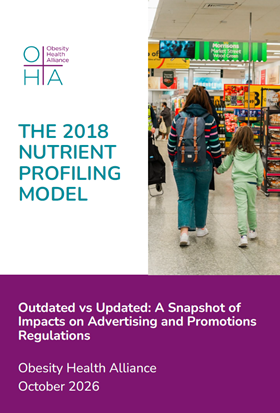
In its latest snapshot, the OHA compared how products are classified as ‘healthy‘ or ‘less healthy’ under the Government’s current 2004/05 Nutrient Profiling Model (NPM) and the updated 2018 NPM.
The analysis found six of the seven food and drink products currently allowed to be advertised during the popular Britain’s Got Talent Final could be reclassified as ‘less healthy’ under the updated NPM.
A similar gap emerged on stores’ shelves. 45 of the 68 in-scope products featured in promotions at the end-of-aisle, such as cakes and biscuits, sugary drinks and desserts and puddings, that currently pass the current NPM could be classed as ‘less healthy’ under the updated equivalent.
Public views
The disconnect is also reflected in public thinking. In polling conducted by researchers Savanta among a nationally representative sample of 2,211 UK adults, 77% described a KFC Zinger Burger as unhealthy, 71% said the same of a McDonald’s Spicy McCrispy and 62% of Walkers Prawn Cocktail crisps.
Surprisingly, these products can still fall outside the advertising and promotion restrictions under the current NPM. This highlights a gap between the rules, evidence and public understanding.
Younger consumers
The polling also demonstrated the scale of children’s exposure to unhealthy food marketing. More than two-thirds of adults (69%) believe children regularly see advertising for unhealthy food and drink, while 57% say the Government should do more to restrict it.
This is despite the Government introducing long-awaited laws to stop less healthy food being advertised before 9pm on TV and through paid-for online media at any time.
In addition, children from the most deprived communities are disproportionately affected by an unhealthy food environment, with one in five leaving primary school with obesity, rising to nearly 30% in the most deprived areas.
In its NHS 10‑Year Health Plan for England, the Government committed to bringing in a Healthy Food Standard - which will require all large food businesses to report on the healthfulness of their sales and be set targets to improve them - vital if the country is to deliver the Government’s ambition of raising the healthiest generation of children ever.
However, the Association of Convenience Stores has also recently called for a delay in the introduction of any new rules to allow the industry to prepare.
New proposals
The OHA is now urging ministers to move quickly to implement both the updated NPM and the Healthy Food Standard. It is now calling on the Government to publish its response to the consultation on applying the updated NPM, which is already past the 12 weeks recommended by Government guidance.
It also asks for the Government to publish the consultation on the Healthy Food Standard immediately, enabling businesses to prepare for and implement mandatory healthy sales reporting and improvement targets.
Thirdly, it is asking for the implementation of the updated NPM and the Healthy Food Standard as soon as possible.
“Families expect the rules on food advertising and promotions to reflect modern nutrition science.”
Katharine Jenner, executive director of the OHA, said: “Families expect the rules on food advertising and promotions to reflect modern nutrition science. Instead, we’re still relying on a model designed more than 20 years ago.

“Both the updated model and the Healthy Food Standard were promised in the NHS 10‑Year Plan, and countries around the world are already modernising how they identify unhealthy products based on the latest evidence - so multinational companies have long known which way the wind is blowing.
“Now they need to be implemented quickly, so the rules make sense to businesses, parents and consumers, and help ensure the food we buy is affordable, available and advertised responsibly.”
Big difference
Beth Bradshaw, policy and advocacy lead of the OHA, added: “Our snapshot analysis shows just how much difference an up-to-date NPM could make.
“The updated model is not about demonising individual foods or telling people what they can and cannot eat. It’s about making sure the rules governing advertising and promotions accurately reflect today’s evidence and give healthier products a fair chance to compete.”

Also commenting, Sonia Pombo, head of research and impact at Action on Salt & Sugar, said: “This report highlights a fundamental problem that too many foods high in fat, salt and sugars are still slipping through the regulatory net. Nutrition science has moved on, the food we buy has changed, and the rules need to catch up.
“We now need stronger rules aligned with the latest nutrition evidence, not outdated standards that allow less healthy products to keep securing prime advertising and retail space.”
Children’s health
Greg Fell OBE, president of the Association of Directors of Public Health, concluded: “The longer we go without enforcing policies that reduce the reach and impact of less healthy food and drink advertising, the more we let the health of our children and wider communities slip through the cracks.

“Evidence shows that where restrictions have been put into place on advertising unhealthy foods and drinks, including across Transport for London services, consumption has reduced.
“The Government must make it a priority to apply the new standard without any further delays so that we can give every child, and our communities, the freedom to lead a healthier life free from the harms of marketing for foods high in fat, sugar, and salt.”









No comments yet